
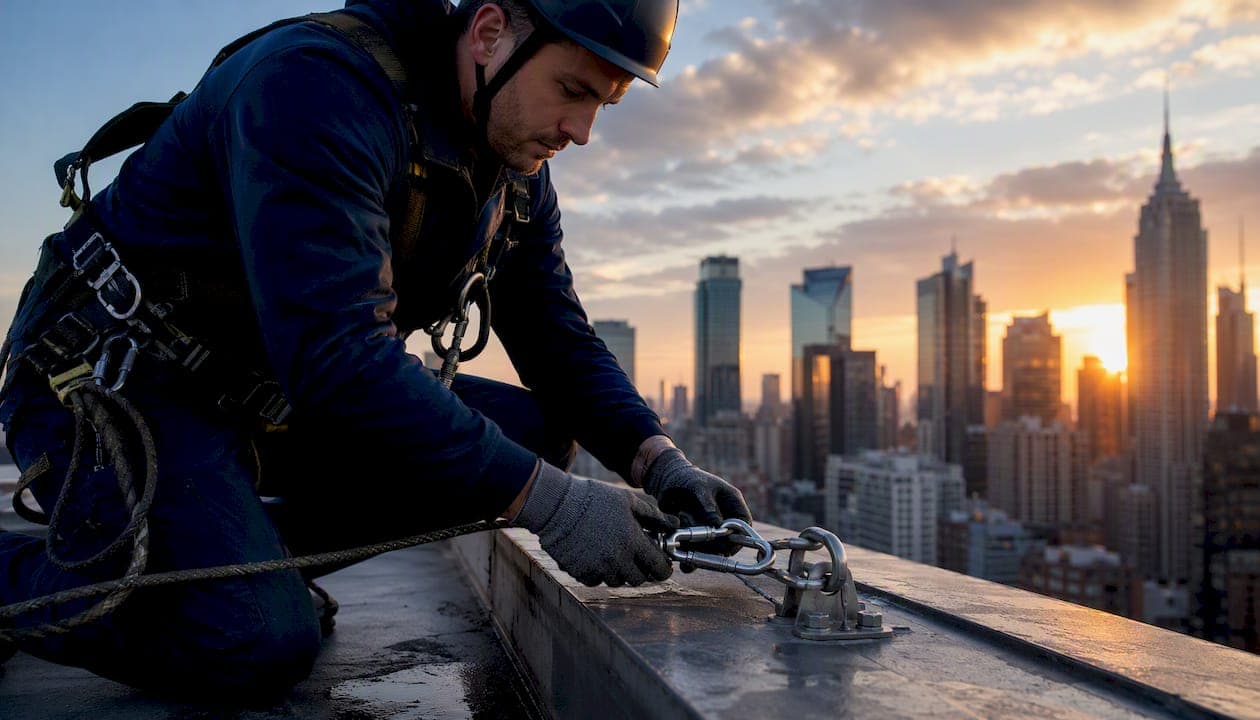
High-rise window cleaning can be performed safely, but only when a documented, site-specific safety plan is in place before a single rope is rigged or a platform leaves the ground. As a facility manager or building owner, your job is not to supervise the work itself. It is to verify, in writing, that the contractor has the controls in place before you sign off.
Before any work begins, insist on every item below. No exceptions:
- Written rescue plan with documented, practiced drills (regular rescue drills are the accepted industry norm)
- Double protection on all rope access work: a primary working line and an independent safety line anchored separately
- Certified operators: IRATA-credentialled technicians for rope access, IPAF-trained operators for powered platforms
- Anchor survey and certification records showing each anchor point has been tested and inspected
- Equipment inspection logs with serial numbers, inspection dates and retirement records
- Public liability and workers' compensation insurance certificates naming your building
Why does this list matter for your liability? Under Australian work health and safety legislation, a person with management or control of a workplace has a duty to ensure, so far as is reasonably practicable, that the workplace is safe. Handing a contractor a set of keys and assuming they know what they are doing is not due diligence. Requesting and retaining these documents is.
Key takeaways
High-rise window cleaning is manageable when facility managers demand specific documentation, verified credentials and practiced rescue capability before any work begins.
| Point | Details |
|---|---|
| Require documentation upfront | Request SWMS, rescue plan, IRATA/IPAF certificates and insurance before awarding any contract. |
| Verify anchor certification | Insist on a written anchor survey completed before rigging, with inspection records retained on file. |
| Confirm rescue drills | Ask for quarterly drill logs with dates, scenarios and after-action notes, not just a written plan. |
| Apply wind-speed controls | Require a specific km/h threshold in the SWMS, not a vague reference to "adverse conditions." |
| Use Shinewisecleaning | Shinewisecleaning provides compliant commercial window cleaning in Canberra and Perth, with full documentation available at tender stage. |
Table of Contents
- Why high-rise window cleaning safety is a legal and financial obligation
- Which access method is right for your building?
- Essential rigging, anchors and PPE for every compliant job
- What competence looks like — and how to verify it
- How to confirm a contractor's rescue plan is real, not a document
- Common hazards and the controls you should expect
- What to include in tenders, quotes and contracts
- How safety requirements affect cost and scheduling
- Key standards and regulatory references to cite in contracts
- Shinewisecleaning's approach to compliant commercial window cleaning
- Sources
Why high-rise window cleaning safety is a legal and financial obligation
The consequences of a fall from height are not limited to the injured worker. A single serious incident can trigger a WorkSafe investigation, halt building operations for days, and expose the building owner to civil liability claims that dwarf the cost of the cleaning contract itself.
Safe Work Australia identifies the primary hazards in industrial rope access as falls, falling objects, pendulum-effect swings, collisions, and environmental conditions including wind, UV, rain and lightning. The guidance is explicit: employers and clients must provide a safe system of work and, where reasonably practicable, prefer fall-prevention controls over fall-arrest controls.
Three bodies set the framework that serious contractors work within:
- Safe Work Australia publishes the Code of Practice for Managing the Risk of Falls at Workplaces and specific guidance on industrial rope access systems, both of which apply to high-rise cleaning in every Australian jurisdiction
- IRATA (Industrial Rope Access Trade Association) operates the globally recognised competency framework for rope access technicians, with three certification levels and mandatory re-assessment every three years
- ISO 22846 provides international recommendations on rope access methods for work at height, intended specifically for employers, clients and practitioners commissioning or performing rope access work
Quarterly rescue drills are the standard industry expectation for active rope access teams. A contractor who cannot produce drill logs from the past three months is telling you something important about how they run their operation.
Which access method is right for your building?
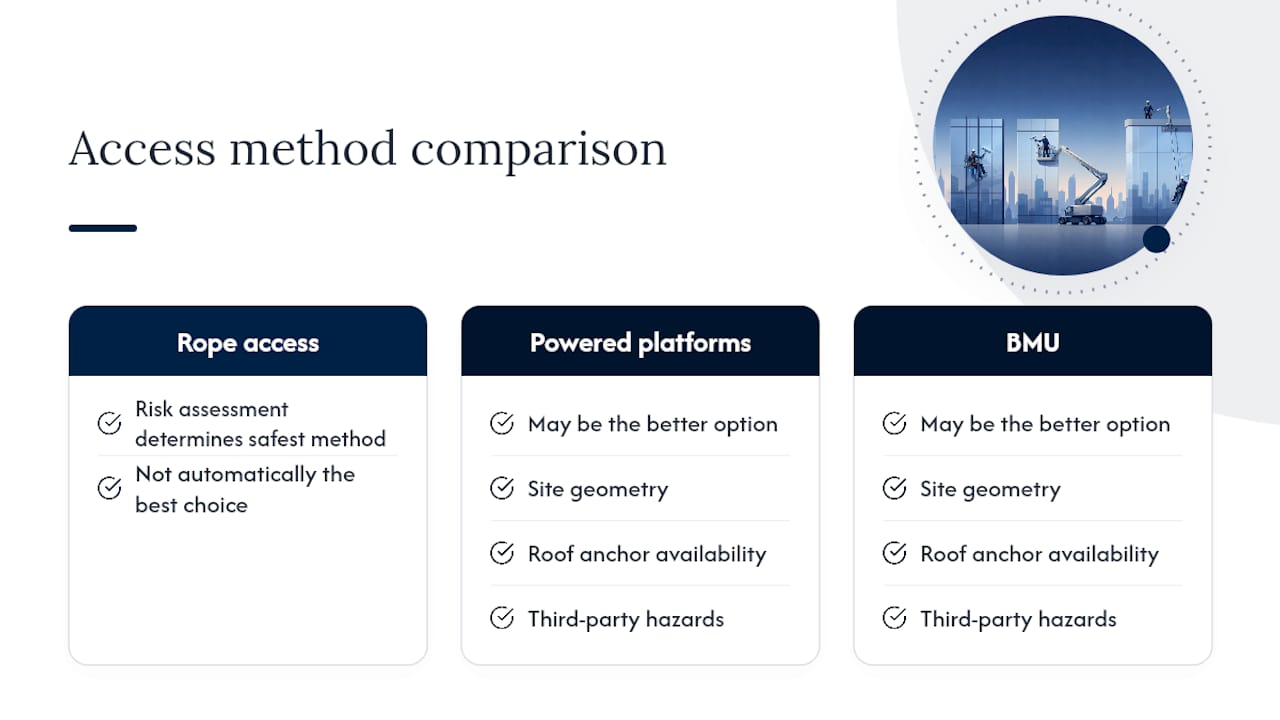
Risk assessment determines the safest method for a given façade. Rope access is not automatically the best choice. Site geometry, roof anchor availability, and third-party hazards can make powered platforms or building maintenance units the better option. Here is how the main methods compare.
Rope access
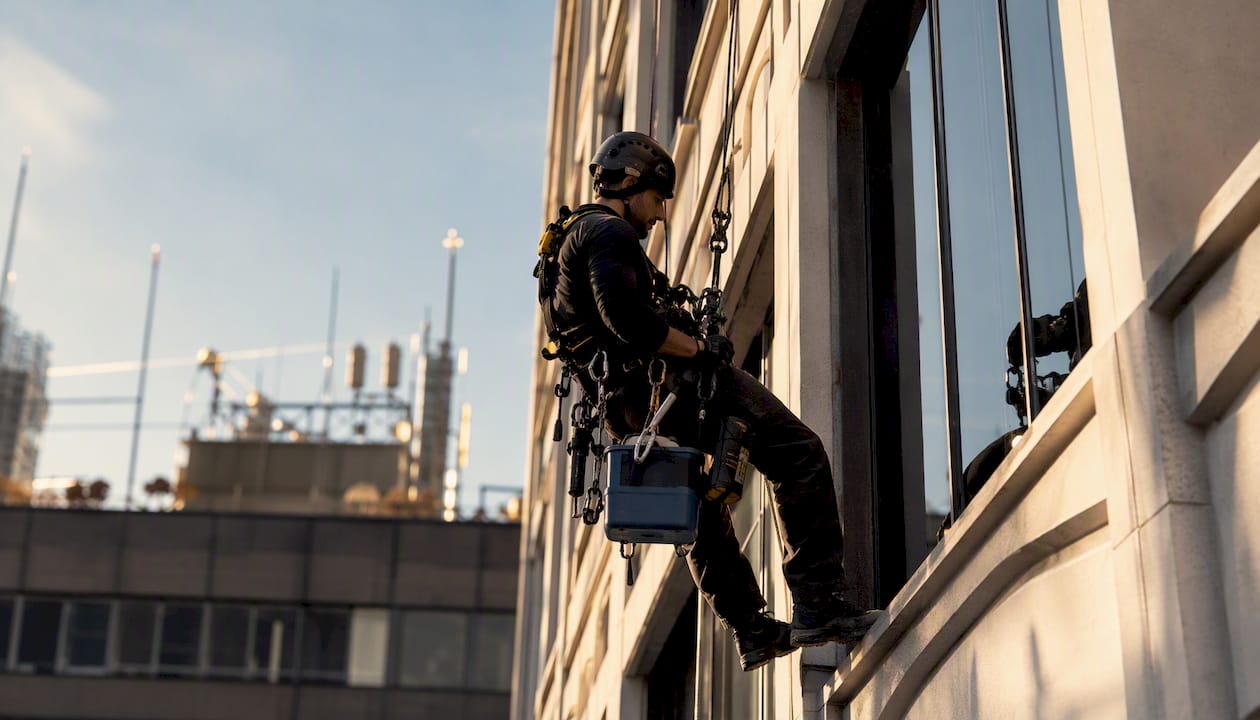
Technicians descend on twin lines from certified roof anchors. The method suits tall, complex façades where installing a cradle track would be impractical, and it requires minimal roof plant. The trade-off is that it demands the highest operator competency and the strictest application of the double-protection principle: every technician must be attached to both a primary working line and an independent safety line anchored at a separate point. IRATA's code of practice requires a documented rescue plan for every suspended worker, with third-party and environmental factors explicitly addressed.
Suspended cradle (BASET platform)
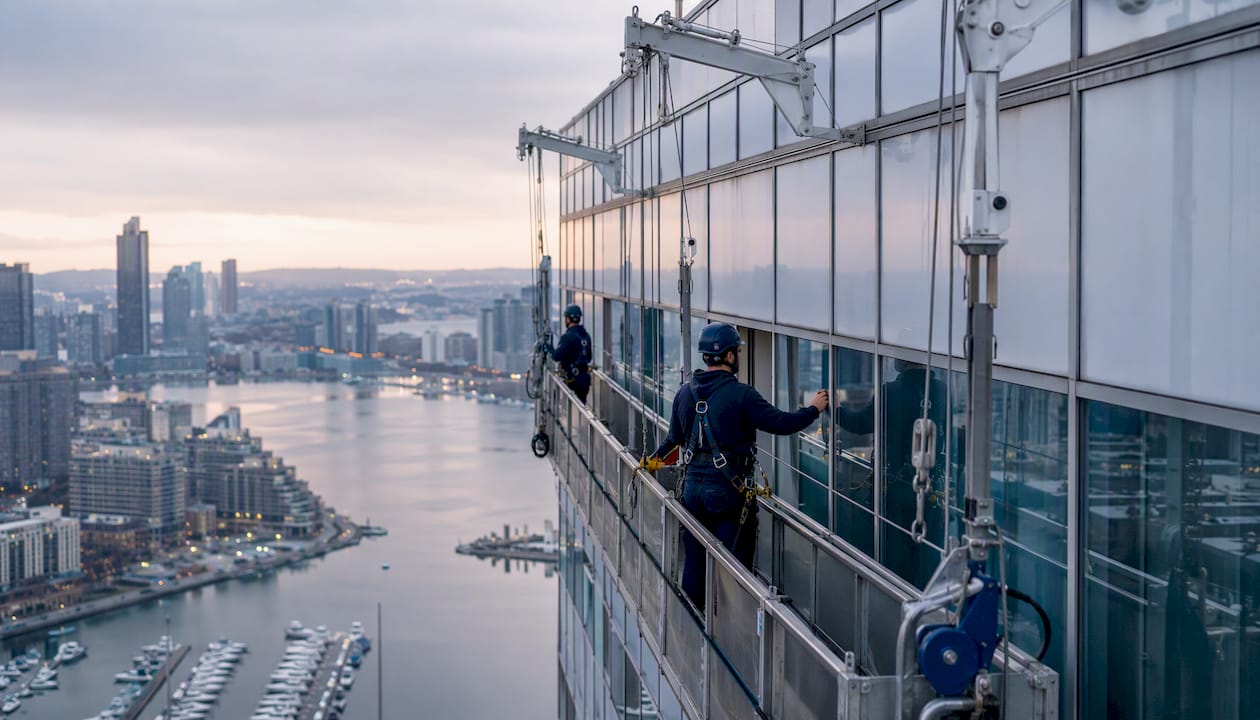
A motorised platform suspended from roof davits or a building maintenance unit (BMU) track. Cradles offer a stable working environment and are well suited to large, regular façades. They require annual certification of the cradle itself, the davit system and the roof anchors. The residual risk is mechanical failure, which makes documented maintenance records non-negotiable.
Elevated work platform (EWP)
Scissor lifts, boom lifts and similar ground-based powered platforms are viable for buildings up to around 12–15 storeys depending on the equipment specification. IPAF training is the recognised competency standard for EWP operators. EWPs eliminate the rope-access rescue scenario but introduce ground-level hazards: tip-over risk, overhead power lines and pedestrian exclusion zones.
Water-fed pole systems
For lower-rise buildings and ground-accessible sections of taller buildings, water-fed poles using purified water are a practical and genuinely low-risk option. No working at height means no fall risk, though chemical handling and ergonomic factors still apply. Pressure washing and water-fed systems are often combined for podium levels and accessible façade sections.
Pro Tip: During a site walk, look up at the roofline and ask the contractor to show you on a sketch where each anchor point sits and which technician will be attached to which anchor. If they cannot answer that question on the spot, their rescue plan is theoretical, not operational.
Essential rigging, anchors and PPE for every compliant job
Equipment failure is the second most common cause of serious incidents in rope access work, after procedural non-compliance. The following items are the minimum you should expect a contractor to specify in their SWMS and demonstrate on site.
Anchor systems
- Certified anchor points with documented load ratings. Industry guidance commonly references a per-worker anchor strength benchmark, and inspection records should be retained and available on request
- Separate anchor points for the primary working line and the safety line — never a shared anchor for both
- Anchor survey completed and photographed before rigging begins, with a written report provided to the building owner
Primary and backup lines
- Primary working line: load-bearing rope with a rope-grab or descender device
- Independent safety line: separate rope with an automatic fall-arrest device (rope grab or similar) that locks under free-fall load
- Both lines inspected before each use and retired on any sign of damage, chemical contamination or UV degradation
Personal protective equipment
- Full-body harness rated to AS/NZS 1891.1, inspected and tagged
- Industrial-rated helmet with an enhanced chin strap — WorkSafe NZ guidance specifically notes that rope-access helmets require enhanced chin straps and industrial ratings, not standard construction-site specifications
- Anti-panic descender or auto-locking connector on the safety line
- Chemical-resistant gloves and eye protection where cleaning agents are in use
Inspection regime
A three-tier inspection system is standard practice for compliant contractors:
- Daily pre-use check by the operator before each shift
- Periodic competent-person inspection at intervals specified by the manufacturer or the contractor's safety management system
- Annual or retirement inspection with records showing the date, inspector name and outcome for every item of life-safety equipment
Ask for the inspection register with serial numbers. If a contractor cannot produce it, the equipment's service history is unknown.
What competence looks like — and how to verify it
Certification is not a formality. An IRATA Level 1 technician has passed a practical assessment covering rope techniques, rescue and emergency procedures. A Level 3 supervisor has demonstrated the ability to plan and supervise complex rope access operations. The three-level structure means you can ask specifically which level each technician on your site holds.
Certifications to request
- IRATA certification card for every rope access technician, showing level and expiry date (re-assessment is required every three years)
- IPAF operator card for any technician operating an elevated work platform or powered cradle
- Rescue training records showing the date and content of the most recent rescue drill for each team member
- Task-specific training records for any non-standard work (e.g. working over water, near power lines, on fragile façades)
How to check on site
Ask to see the physical IRATA card, not a photocopy. IRATA cards carry a unique ID that can be verified through the IRATA online registry. Do the same check during tender evaluation: request scanned copies of all cards and cross-reference the expiry dates against the planned work date. A card that expires mid-contract is a compliance gap.
Refresher training and rescue practice should be documented in a training register. Ask for the register as part of the tender response, not as an afterthought once work has started.
How to confirm a contractor's rescue plan is real, not a document
A rescue plan that lives in a folder and has never been practiced is not a rescue plan. It is a liability document. The distinction matters because a suspended worker who cannot self-rescue within a few minutes faces suspension trauma, a time-critical medical emergency. The rescue must be executable by the on-site team, not dependent on calling emergency services.
What a compliant rescue plan must cover
- Types of rescue applicable to the site (assisted lower, pick-off, counterbalance)
- Equipment staged and ready at the work area before work begins, not stored in a van
- Anchor points designated for rescue use, separate from working anchors where possible
- Third-party interactions: cranes, other contractors on the roof, public access below
- Environmental triggers: the wind speed or weather condition at which work stops
- Emergency contact chain and communication protocol
IRATA's code of practice requires that rescue planning explicitly account for anchors, third-party actions, weather and other environmental hazards. A plan that does not address these factors does not meet the standard.
Drill frequency and evidence
Quarterly rescue drills are the accepted industry expectation for active rope access teams. Ask for the drill log. It should show the date, scenario practiced, participants, outcome and any corrective actions. Photos from the drill are a strong indicator that the exercise was genuine rather than a box-tick.
Pro Tip: At the site induction, ask the supervisor to walk you to the rescue equipment and explain, in two minutes, how they would retrieve a suspended worker from the most difficult anchor point on your building. The quality of that answer tells you more than any document.
A contractor who has never practiced a rescue on a building similar to yours is asking you to trust a plan they have never tested.
Common hazards and the controls you should expect
| Hazard | Practical controls |
|---|---|
| Fall from height | Double protection (primary + independent safety line), certified anchors, full-body harness to AS/NZS 1891.1, pre-use equipment check |
| Dropped objects | Tool tethering (lanyards on every tool), exclusion zones below the work face, debris netting or catch platforms, public barricading |
| High wind | Site-specific wind threshold in the SWMS; FISAT guidance advises monitoring wind speed at working height and halting work when conditions exceed safe thresholds |
| Electrical hazards | Minimum clearance distances from power lines documented in SWMS; work halted if clearance cannot be maintained |
| Chemical exposure | Safety Data Sheets (SDS) for all cleaning agents on site; chemical-resistant PPE; sanitising and chemical handling protocols documented |
| Ergonomic strain | Task rotation, weight limits on equipment carried by technicians, harness fit checks before each shift |
| Third-party interaction | Exclusion zones enforced, communication protocol with roof-level contractors, crane-lift coordination documented |
| Environmental conditions | UV protection, hydration protocols, lightning monitoring, work suspension criteria in SWMS |
Pro Tip: Ask the contractor to show you the wind-speed trigger in their SWMS. If it says "work stops in high winds" without a specific speed, it is not a control — it is a wish.
What to include in tenders, quotes and contracts
Scoring bids on price alone is the single fastest way to inherit a contractor's safety failures. A compliant tender response for high-rise window cleaning should include every item below. Use this as your evaluation checklist.
Documentation to require with every tender response
- Site-specific SWMS addressing the access method, hazards and controls for your building
- Written rescue plan with scenario descriptions and equipment list
- IRATA certification cards (or equivalent) for all rope access technicians, with expiry dates
- IPAF operator cards for any powered platform work
- Equipment inspection register with serial numbers and last inspection dates
- Anchor certification records or a commitment to complete an anchor survey before work begins
- Public liability insurance certificate (minimum $20 million is common for commercial work) naming the building owner as an additional insured
- Workers' compensation insurance certificate
Suggested contract clauses
- Require the contractor to complete an anchor survey and provide a written report at least five business days before work commences
- Name the building owner as an additional insured on the contractor's public liability policy
- Include a 30-day written cancellation notice period
- Require written notification of any incident, near-miss or equipment failure within 24 hours
- Specify that the SWMS must be reviewed and re-signed by the supervisor if site conditions change materially
Scoring bids on safety
Weight safety documentation at least equally with price. A contractor who cannot provide a site-specific SWMS and rescue plan at tender stage will not produce one on the day of the job. For strata and commercial buildings where multiple stakeholders share liability, this weighting is especially important.
How safety requirements affect cost and scheduling
Safety controls cost money, and that cost is legitimate. A contractor quoting significantly below market rate for high-rise work is almost certainly cutting something. Here is where the money goes and why it matters.
Cost drivers
- Height and façade complexity: more rope runs, more anchor points, longer rigging time
- Anchor survey and certification: a structural engineer or specialist anchor tester charges separately; budget for this as a one-off or periodic cost
- Rescue staging: equipment, time and personnel dedicated to rescue readiness add to the day rate
- Certified crew: IRATA-credentialled technicians command higher rates than uncertified labour, reflecting the training investment and re-assessment cycle
- Insurance: adequate public liability coverage for high-rise work carries a meaningful premium
Scheduling factors
Wind is the most common cause of unplanned delays. A SWMS with a specific wind-speed threshold means work stops when that threshold is reached, regardless of the day's schedule. Build weather contingency into your programme. Daylight access is a real constraint for rope access: technicians need sufficient light to inspect equipment and manage lines safely.
Tenant and occupant notifications should go out at least 48 hours before work begins. For buildings with after-hours scheduling requirements, confirm the contractor can work within those windows without compromising the rescue plan (a nighttime rescue scenario requires lighting provisions that must be documented).
The upfront cost of a compliant contractor is predictable. The cost of a serious incident is not.
Key standards and regulatory references to cite in contracts
Reference these documents in your tender specifications and contract. Asking a contractor to confirm compliance with each one is a fast filter for competence.
- Safe Work Australia — Guide to Managing the Risks of Industrial Rope Access Systems — the primary Australian guidance document covering hazards, safe systems of work and fall-prevention hierarchy for rope access
- IRATA International Code of Practice (ICOP): the industry standard for rope access competency, rescue planning and operational requirements; ask the contractor to confirm their operations comply with the current edition
- ISO 22846: international guidance on rope access methods for work at height; useful as a reference standard in contracts with international contractors or on projects with international oversight
- IPAF training standards: the recognised competency framework for powered access equipment operators; request IPAF operator cards for any EWP or cradle work
- FISAT guidance: European technical guidance on wind-speed thresholds, anchor requirements and safety system definitions; useful as a supplementary reference for wind-limit clauses
For each standard, ask the contractor to identify in their SWMS where and how they meet the relevant requirement. A contractor who cannot map their procedures to these documents is working from habit, not from a managed safety system.
Shinewisecleaning's approach to compliant commercial window cleaning
Shinewisecleaning operates across Canberra ACT and Perth WA with police-checked teams, documented cleaning checklists, and a commitment to the same compliance rigour this article describes. For commercial and high-rise window cleaning, Shinewisecleaning provides a full tender response package: site-specific SWMS, rescue plan documentation, equipment inspection records, and evidence of operator training. Insurance certificates are available on request, and a pre-site inspection can be arranged to assess anchor points and access constraints before any quote is finalised.
If you manage a commercial building and want a contractor who can hand you the paperwork before the conversation about price, get a quote from Shinewisecleaning or explore the full range of commercial cleaning services available across both cities.
What actually works in practice
The most common decision I see facility managers get wrong is treating method selection as the contractor's problem. It is not. When a building owner asks "rope access or cradle?" and then defers entirely to the contractor's answer, they lose the ability to evaluate whether the answer is driven by safety or by what the contractor already owns.
The practical check that settles the question is simple: ask the contractor to show you, on your building's roof plan, where each anchor sits, which technician is attached to which anchor, and where the rescue equipment will be staged. If the rescue equipment is staged at the anchor furthest from the most difficult access point, that is a planning gap. If they cannot answer the anchor question at all, rope access is not the right method for this contractor on this building, regardless of their IRATA cards.
Documented rescue drills are the other non-negotiable that separates compliant contractors from paper-compliant ones. A drill log with dates, scenarios and corrective actions is a living document. A drill log with identical entries every quarter is a template. Ask to see the after-action notes. Real drills produce real problems and real fixes.
Sources
Use these primary sources when vetting contractors or drafting tender specifications:
- IRATA International Code of Practice for Industrial Rope Access (Annex R — Rescue)
- Guide to managing the risks of industrial rope access systems — Safe Work Australia
- ISO 22846 — Personal equipment for protection against falls — rope access systems (guidance)
- FISAT guidance (FSR_SZP_Version_15.3_en.pdf)
- High-Rise Window Washing Safety Standards — RBM Building Services
When reviewing a contractor's tender response, cross-reference their SWMS against each of these documents. A contractor who can point to specific clauses in their procedures that address IRATA rescue requirements, Safe Work Australia hazard controls and AS/NZS 1891 equipment ratings is operating from a managed system, not from memory.